
À In the age of ultra-fast digital printers capable of producing millions of synthetic pixels in a matter of seconds, choosing the hand screen printing on a carousel is an act of aesthetic resistance. For Kanten, printing a design on a T-shirt is not merely a logistical process: it is an extension of an engraver’s craft, where the refined chemistry of pigments meets the living fiber of a heavyweight 240 g/m² organic cotton jersey.
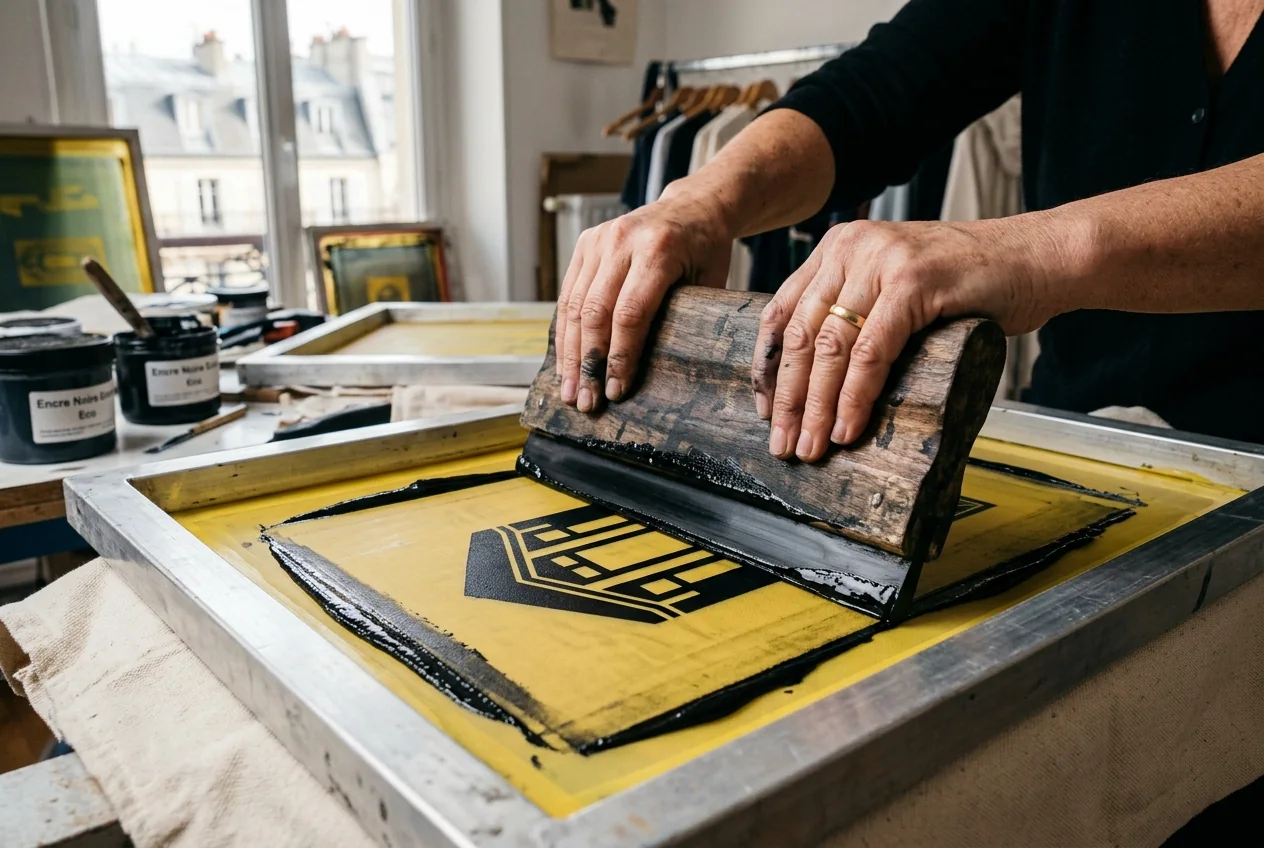
In our Parisian studio, every print is a physical dialogue. There, you can smell the distinctive scent of fresh emulsion, hear the muffled click of the aluminum frame as it lowers precisely onto the squeegee, and feel the incomparable silky glide of the polyurethane squeegee as it deposits the pigment deep into the fabric.
From the proof to the frame: The darkroom and UV exposure
It all begins long before the printing press, in the dim light of our photogravure lab. The master for each image is first printed onto a high-density transparent film called the typon. The black areas must be completely opaque to block out all light.
At the same time, an aluminum frame stretched with an ultra-fine polyester mesh (selected between 77T and 120T depending on the fineness of the line work) is coated with a thin layer of photosensitive emulsion. After drying in the dark, the frame is then placed on our exposure table under intense ultraviolet light. The areas protected by the black of the artwork remain water-soluble; the exposed areas harden instantly.
When the design is washed away with a high-pressure water jet, the magic happens: the pattern appears in perfect negative through the open mesh of the fabric. The stencil is ready.
«In manual screen printing, there is no 'undo' button. The accuracy of the result depends entirely on the artisan's eye, the tension in their arm, and their control of their breath at the precise moment the squeegee passes through the screen.»
Thomas — Master Screen Printer at Atelier Kanten
The 45-Degree Squeegee Stroke: The Artisan's Breath
Placed on the manual carousel with micrometric indexing, the frame is fed a strand of creamy ink. This is where the artisan’s muscle memory comes into play:
- The topping: With a light, even stroke of the squeegee—applied flat and without pressure—the ink is spread evenly across the entire surface of the screen to fill the mesh without bleeding through.
- The print run: The squeegee is tilted at a precise 45° angle. With a continuous, firm, and steady motion, the screen printer pushes the ink through the mesh. Too much pressure would crush the fabric weave; too little pressure would leave gaps. The ink must settle precisely between the cotton fibers.
- The clearance: The frame is lifted with a quick motion to prevent any suction effect that might blur the sharpness of the contours.
100% Solvent-Free Water-Based Inks (Oeko-Tex Standard 100)
The conventional textile industry makes extensive use of plastisol inks, which are formulated with PVC resins and toxic petroleum-derived phthalates. These inks form a rigid plastic crust that suffocates the skin and crumbles after the first wash.
At Kanten, we have eliminated all petrochemical-based inks in favor of'water-based, water-soluble, solvent-free inks :
- Imperceptible touch («gentle touch»): The ink penetrates deep into the cotton fiber rather than remaining on the surface. The fabric retains its full breathability.
- Zero toxic emissions: There are no volatile organic compounds (VOCs) in our workshop, ensuring the health of our artisans.
- Deep mineral colors: Deep charcoal blacks and ecru shades that age gracefully, developing a patina over time.
Thermal Polymerization at 160°C: The Test of Durability
Once printed, the garment cannot be worn immediately: the water-based ink must undergo a fundamental chemical reaction called the polymerization. The T-shirt then passes through a continuous-conveyor thermal drying tunnel, where it is exposed to a controlled temperature of 160°C for three full minutes.
Under the effect of this intense heat, the water evaporates and the polymer binders cross-link around the cotton’s cellulose molecules. The ink and the fiber become one. It is this meticulous process that ensures that our Screen-printed T-shirts They can withstand hundreds of machine washes without ever cracking, fading, or losing their graphic contrast.
Manual Screen Printing vs. Industrial Digital Printing
When you choose a screen-printed garment from Kanten, you’re supporting a thriving workshop tradition and treating yourself to a numbered textile print. To explore the possibilities of custom design and apply exclusive graphics to your garments, visit our interactive studio Custom Lab or find out how our clothes are made in our feature on local Parisian crafts.
Matching pieces in the Kanten wardrobe
Kyu Graphic T-Shirt
GOTS-certified organic cotton, hand-screen-printed with solvent-free water-based ink, barely noticeable to the touch.
Uzu Minimalist T-shirt
An art print inspired by the movement of ocean waves, in deep black on mineral white.
Custom Lab Workshop
Create your own geometric design, which will be heat-applied in our workshop.
 English
  French